

Ingush State University
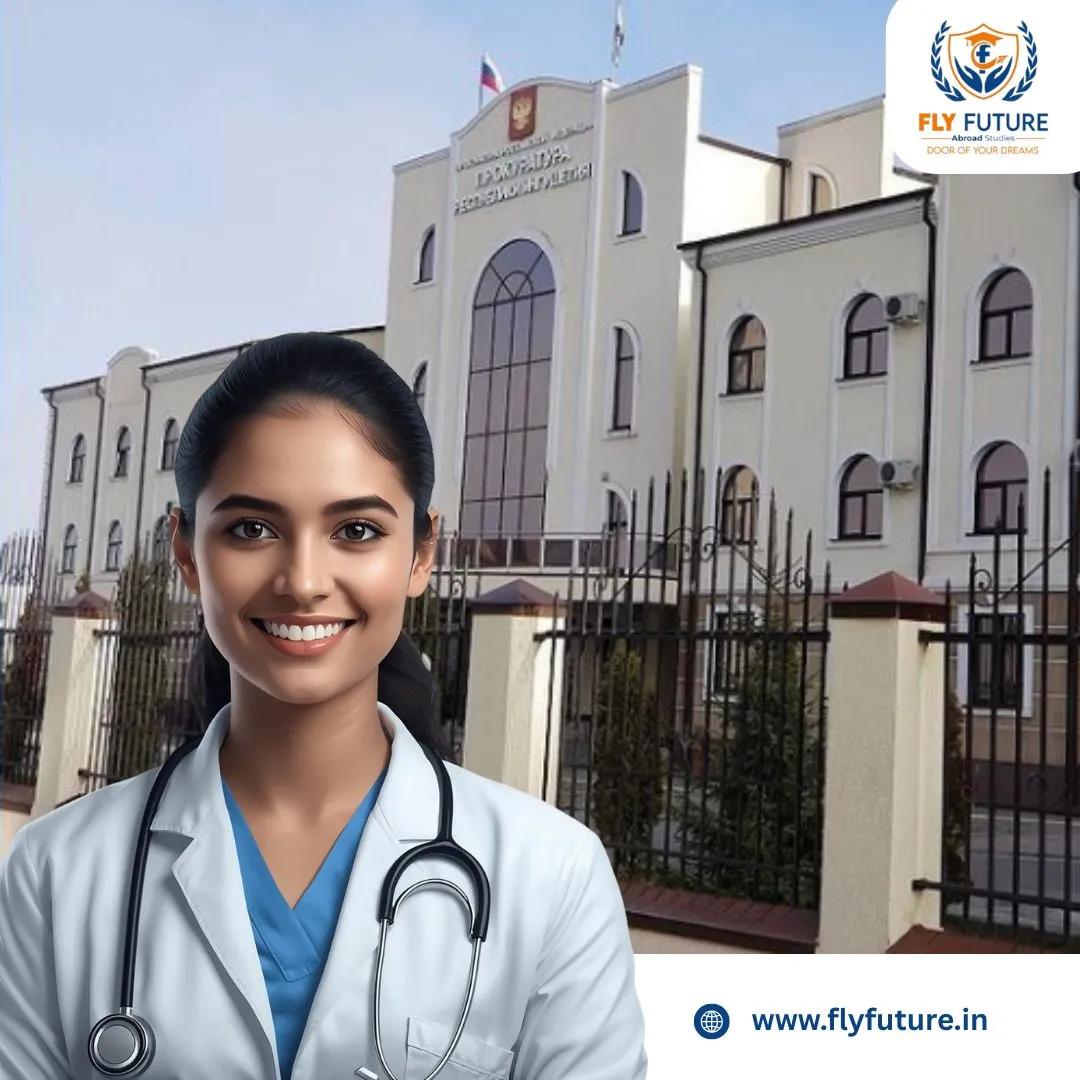
Ingush State University Russia 2026-27 | Study MBBS in Russia
Ingush State University was founded in 1994 . It is a public university in the Municipality, Asan Republic.There are 508 academic staff who provide the best education. This university has trained more than 8000+ students in higher education.We can say that Ingush State University is one of the best medical universities in Russia to study MBBS abroad.
Ingush State Medical University is affiliated with WHO (World Health Organization), Ministry of Science and Higher Education of Russian Federation, NMC (National Medical Commission) etc.
The program is described as full-time in the official university information. In addition, the institute features a morgue, an anatomical museum, practical skills facilities, a simulation and accreditation center, and theoretical and clinical departments.
However, it is crucial to distinguish between a university's general availability of a medical program and an individual's eligibility to use that qualification for medical practice in another country, especially for applicants from India. The National Medical Commission (NMC) of India's current regulations, the applicable regulations for foreign medical graduates, the university's current program details, the language of instruction, and the clinical training arrangements should all be independently verified by students.
Ingush State University is one of the principal higher-education institutions of the Republic of Ingushetia. The university was created in 1994 during a period when the newly established republic needed its own higher-education and professional training infrastructure.
Rather than being a university dedicated exclusively to medicine, IngGU is a multidisciplinary public university. Its academic environment covers several areas, allowing medical students to study within a broader university ecosystem.
Ingush State University Ranking :
Country : 331
World : 8152
QUICK HIGHLIGHTS ABOUT INGUSH STATE MEDICAL
| Particular | Details |
| University | Ingush State University |
| Common abbreviation | IngGU |
| Country | Russia |
| Republic | Ingushetia |
| City | Magas |
| Type | Public university |
| Established | 1994 |
| Medical education started | 1997 |
| English programme listing | Medicine (in English) is listed on Study in Russia |
| Study mode | Full-time |
ELIGIBILITY FOR MBBS ADMISSION AND DOCUMENTS REQUIRED:-
ELIIBILTY CRITERIA
- Candidate must have Indian Nationality.
- Candidate must have clear 12th standard in Physics, Chemistry, Biology and English subjects.
- The applicant must be 17 years old by December 31 of the year of application.
- Applicant must clear NEET exam.
REQUIRED DOCUMENTATION
- 10th and 12th passing marks and transfer letters
- Bachelor's graduation certificate and transfer certificate
- Copy of international passport (should be valid for at least 2 years) and any other proof of identity.
- 8 passport size photos.
- Bank balance certificate or financial documents.
- Return ticket with an open return date within 1 year of arrival.
- Mental and physical fitness confirmed by the Ministry of Foreign Affairs.
- Birth certificate on arrival
HOSTEL ACCOMODATION:-
- Each campus room includes a bed, pillow, mattress, blanket, table with chair, water heaters and suitable lighting for studying and relaxing.
- All rooms in the hostel are furnished and vary in size and Wi-Fi in most rooms.
- Dormitories can accommodate 2 or 3 students in each room.
- There are common areas where students can socialize and can arrange a sports, cultural and educational program.
- Each room in the campus is equipped with a kitchen where students can cook the food of their choice. Students will only need to arrange their own dishes and cooking.
- The administrative unit of the university is responsible for housekeeping, room cleaning and student safety.
- For international students, there is a canteen provided by the campus according to their diet.
- Attached washrooms are available in all rooms
Ingush State University Fees Structure 2026-27
| University | 1st Year | 2nd Year | 3rd Year | 4th Year | 5th Year | 6th Year | Total |
|---|---|---|---|---|---|---|---|
| Ingush State University | 2,20,000 RUB | 2,20,000 RUB | 2,20,000 RUB | 2,20,000 RUB | 2,20,000 RUB | 2,20,000 RUB | 13,20,000 RUB |
| Ingush State University | 2,20,000 INR | 2,20,000 INR | 2,20,000 INR | 2,20,000 INR | 2,20,000 INR | 2,20,000 INR | 13,20,000 INR |
Note :
1 RUB = 1 INR
Hostel Fee : 600$ = 45000 INR Per Year (Approx)
Visa & Medical Insurance : 200$ = 15000 INR Per Year (Approx)
Ingush State Medical University vs Other Russian Medical Universities
| Feature | Ingush State University | Tyumen State Medical University | Kazan Federal University | Volgograd State Medical University |
| Location | Magas, Ingushetia, Russia | Tyumen, Siberia | Kazan | Volgograd |
| Established Year | 1994 | 1963 | 1804 | 1935 |
| NMC/WHO Recognition | Yes | Yes | Yes | Yes |
| Duration | 6 years (incl. internship) | 6 years | 6 years | 6 years |
| Medium of Instruction | English | English | English | English |
| Clinical Exposure | Good, hands-on training | Good, extensive clinical facilities | Strong | Strong |
| Indian Student Support | Indian mess & culture sensitive | Indian mess & cultural support | Indian facilities available | Indian facilities available |
| FMGE Pass Rate | Approx. 23% (competitive) | Competitive | Good | Good |
Ingush State Medical University vs Indian Medical Universities
| Feature | Ingush State University | Indian Government Medical College | Indian Private Medical College |
| NMC/WHO Recognition | Yes | Yes | Yes |
| Course Duration | 6 years (incl. internship) | 5.5 years | 5.5 years |
| Medium of Instruction | English | English, regional languages | English |
| Donation/Capitation Fees | No | No | Usually high |
| Entrance/Competition | Moderate (NEET qualified) | Very high (NEET ranking) | Varies, expensive |
| Clinical Exposure | Good practical training | Strong established hospitals | Variable |
| Degree Recognition | Globally recognized | Mostly Indian recognition | Mostly Indian recognition |
Why to choose Ingush State University ?
- Internationally recognized.
- The courses are certified by WHO, UNESCO, PLAB (UK), USMLE (USA), MCI, PMDC and other international organizations.
- No entrance exam or IELTS / TOEFL is required.
- Affordable tuition and accommodation.
- Complies with European standards.
- The medium of study is English, French and Russian.
- Practical knowledge and great job opportunities.
- Mild climate and excellent transport accessibility.
- Experienced teachers worldwide.
- Opportunities provided to students to attend a seminar or work on project work etc. in many European cities.
- Great benefits for permanent residence and accommodation in Europe after graduation.
English-language Medical
The availability of an English-language medicine listing is one of the most important features for foreign applicants.
Ingush State University's Medicine program, which is currently listed on the Study in Russia portal in English, prepares physicians to treat acute and chronic illnesses, provide primary care, and engage in preventive healthcare.
Before being admitted, students should, however, confirm the precise language arrangement directly with the university.
Advertising a program as English-medium does not guaranty that all clinical interactions, hospital records, patient communications, and practical activities will be conducted solely in English.
Faculty & Academic Structure
1. Medical Faculty
The Faculty of Medicine was founded to meet local medical needs and provides education in pathology, surgery, general healthcare, and diagnostics. Its General Medicine (equivalent to MBBS) program includes clinical collaborations with local hospitals and specialized laboratory facilities.
2. Mathematics and Physics Faculty
covers software engineering, computational data analysis, applied mathematics, and basic physics.
3. Chemistry and Biology Faculty
offers instruction in environmental biology, microbiology, biochemistry, organic and inorganic chemistry, and ecological preservation.
4. Law and Economics Faculty
provides legal and economic education with an emphasis on public administration, corporate accounting, international trade, criminal jurisprudence, and civil law.
5. Agricultural Engineering Faculty
focuses on agricultural machinery engineering, contemporary agronomy, sustainable farming practices, and regional food security.
 Academic Training in the Early Years
Early medical education is typically heavily focused on science.
Before they can confidently diagnose and treat illness, students must have a solid understanding of the human body.
Anatomy
- The structural basis of medicine is provided by anatomy. The locations and connections between organs, tissues, vessels, nerves, and anatomical systems are taught to students.
- Human anatomy is one of the theoretical departments at IngGU's medical institute, which also has an anatomical museum.
Physiology
- How the body functions is explained by physiology.
- Cellular mechanisms are followed by organ systems, cardiovascular function, respiratory physiology, renal function, endocrine systems, and nervous system regulation.
Histology and associated fields of study
Students can better comprehend tissues and organ structures by studying microscopic anatomy. It aids in subsequent pathology education.
Biochemistry
- Biochemistry links metabolism, disease mechanisms, and laboratory medicine to biological processes.
- Despite their theoretical appearance, these foundational disciplines eventually gain clinical relevance.
Training in Practical Skills and Simulation
The university's simulation and accreditation center is one of its noteworthy facilities.
According to the university, the center was founded in tandem with Russia's implementation of primary accreditation for medical graduates. There is also a practical skills classroom at the institute.
Before carrying out medical procedures under supervision in actual clinical settings, students can practice them in a controlled setting with the aid of simulation-based training.
Potential training areas can include:
- Basic clinical examination
- Emergency response
- Patient assessment
- Injection techniques
- Resuscitation principles
- Practical procedural skills
- Clinical decision-making
Faculty & Teaching Staff Profile
| Category / Metric | Details & Data | Key Highlights |
| Total Academic Staff (University-Wide) | 508+ Academic Staff | Includes full-time professors, readers, senior lecturers, and clinical instructors. |
| Medical Faculty Cadre | 120+ Medical Educators & Specialists | Comprises Doctors of Medical Sciences (Doktor Nauk), Candidates of Medical Sciences (Kandidat Nauk), and practicing hospital physicians. |
| Student-to-Teacher Ratio | 1:20 | Facilitates personalized clinical supervision and small-group laboratory mentoring. |
| Academic Credentials | >65% Advanced Degree Holders | Over 65% of medical faculty hold higher research doctorates or clinical specialist titles recognized by the Russian Ministry of Science and Higher Education. |
| Medium of Instruction Staff | Bilingual Medical Educators | Professors teaching international streams are certified to deliver lectures and clinical clerkships in 100% English. |
| Key Clinical Departments |
• Human Anatomy & Histology |
Faculty departments are divided into basic medical sciences (pre-clinical) and hospital-based clinical departments. |
NMC and Foreign Medical Graduate Considerations
For Indian applicants, this is one of the most crucial sections.
The ability of a graduate to apply for medical registration in India depends on the relevant Indian regulations and whether the individual's course and training meet those requirements, even if the foreign university is recognized as legitimate in their home country.
Before being admitted, students should review the most recent requirements that apply to foreign medical graduates.
Recognition and Verification
Students should conduct verification in several stages.
University verification
Check:
- Official university identity
- Programme code
- Degree title
- Current tuition
- Admission rules
- Campus
- Faculty
- Programme language
Russian-side verification
Check:
- Institutional status
- Right to offer the programme
- Current educational documentation
- Licensing information where applicable
Indian-side verification
Check:
- NMC rules
- NEET requirement
- Foreign medical graduate regulations
- Applicable licensing/screening examination requirements
- Internship requirements
FAQ's
1. What are the prerequisites for admission to the MBBS program ?
- Candidates must have completed Physics, Chemistry, and Biology in their 10+2 or its equivalent.
- For general categories, the minimum PCB aggregate marks are 50%; for reserved categories, they are 40%.
- For Indian students, passing the NEET is a requirement.
- By December 31 of the admission year, the applicant must be at least 17 years old.
- Since English is the medium of education, fluency in the language is necessary.
2. What documents is needed for the admissions procedure ?
- Certificates and mark sheets for grades 10 and 12.
- A passport that is valid for at least 18 months.
- Evidence of citizenship and a birth certificate.
- NEET scorecard.
- Certificate of medical fitness that includes HIV and COVID-19 reports.
- Photos the size of a passport with a white background.
- For financial evidence, use a bank statement.
- Letter of admission for a visa application.
3. When is the time to apply for admission ?
Early in the year is when admissions open, and final enrollment often ends in July or August.
4. Are there facilities for Indian cuisine and culture ?
Yes, there are Indian dining options and cultural support programs available on campus.
5. How long is the MBBS program and what language is it taught in ?
- The six-year MBBS program includes an internship.
- English is the primary language of instruction.
- To make clinical practice easier, more Russian language instruction might be added.
6. Does Ingush State University have international and Indian recognition ?
- The WHO has listed the university and the National Medical Commission (NMC) of India has acknowledged it.
- Both in India and overseas, graduates are qualified to take the FMGE and license tests.
7. Does admission involve taking entrance exams ?
The university does not administer a separate entrance exam for Indian students; instead, admission is determined by academic credentials and qualifying NEET scores.
8. What resources are accessible for students ?
- Indian dining establishments and cultural assistance.
- Labs, research facilities, and classrooms that are up to date.
- Secure hostels.
- Social and extracurricular events for students from other countries.
Best Russian Medical Universities :
- Crimean Federal University
- Kazan State Medical University
- Kursk State Medical University
- Kazan Federal University
- Bashkir State University
- Ulyanovsk State University
- Peoples’ Friendship University